
Meta Description:
Discover how upcycling denim scraps into a handmade cat tote bag combats digital fatigue and brain rot. Complete verified materials list, dimensions, and craft psychology.
The Resurgence of Tactile Craft in a Disposable Culture
In an economy saturated by fast fashion and fleeting digital impressions, mass-produced accessories have largely lost their character. Simultaneously, screen-centric lifestyles have created widespread cognitive depletion—often colloquially termed “brain rot.”
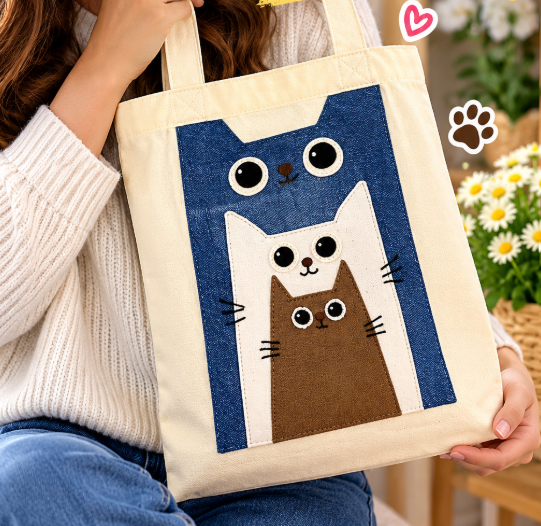
Transforming discarded textiles into functional art addresses both dilemmas at once. This upcycled denim cat tote bag breathes new life into worn-out jeans and remnant fabrics, pairing sustainable zero-waste sewing with the charm of a geometric three-cat appliqué. Featuring a dedicated phone slip pocket and a secure snap closure, it combines minimalist utility with lasting personality.
Before gathering your fabric scissors and thread, it helps to understand why stepping away from the glass screen to build something physical is one of the most effective mental resets available today.
The Cognitive Antidote: How Physical Making Reverses Digital Overload
“Brain rot” is more than a cultural buzzword; it reflects a well-documented state of executive dysfunction, cognitive fatigue, and fractured attention caused by chronic doomscrolling and passive media consumption. Engaging in precision textile crafts provides a direct neurological counterbalance through several key mechanisms:
1. Disrupting the Passive Dopamine Feedback Loop
Endless short-form video feeds condition the brain to expect instant, effortless stimulation. This over-saturates dopamine pathways and results in brain fog, apathy, and restlessness. Physical crafting demands deliberate effort: selecting textures, measuring angles, aligning shapes, and pressing seams. The satisfaction of finishing a usable, durable tote bag delivers earned dopamine, reinforcing patient problem-solving and long-term task satisfaction.
2. Induction of Deep Psychological Flow
Coined by psychologist Mihaly Csikszentmihalyi, the flow state represents total, tranquil absorption in a tangible task. Guiding fabric under a humming needle or matching geometric curves dampens overactivity in the brain’s Default Mode Network (DMN)—the neural circuit responsible for anxiety, chronic overthinking, and digital stress. Crafting acts as an active, somatic meditation that grounds you in the immediate present.
3. Bilateral Motor Coordination and Neural Plasticity
Operating a sewing machine while stabilizing fabric requires fine motor control, real-time spatial awareness, and coordinated movement from both hands. This simultaneous cross-hemispheric communication stimulates neuroplasticity, keeping neural connections sharp and reinforcing spatial problem-solving skills that passive screen use gradually dulls.
4. Somatosensory Grounding
Digital devices offer uniform, slick glass surfaces devoid of texture. Sewing introduces varied tactile inputs: the coarse twill of aged denim, crisp woven cotton, slick fusible interfacing, and the warmth of a steam-pressed hem. This sensory variety acts as tactile grounding, reducing circulating stress hormones and restoring mental clarity.
Complete Tools & Verified Materials Checklist
To ensure accurate scaling and seamless construction, all dimensions and materials below reflect the exact technical requirements shown in the accompanying tutorial.
1. Fabric Inventory
- Main Tote Bag Body: 1 piece of heavyweight natural cotton canvas, duck cloth, or unbleached calico measuring
60×70 cm60×70 cm(≈23.6×27.6 inches≈23.6×27.6 inches). - Denim Scraps (Large Cat Silhouette): Medium- to heavyweight rigid or low-stretch discarded blue jeans.
- Beige / Off-White Fabric Scraps: Medium Cat silhouette and the outer eye borders of the large cat.
- Brown Twill / Cotton Scraps: Small Cat silhouette.
- Black Cotton Scraps: Inner pupils for all three cats and small nose accents.
- Fusible Interfacing (Single-Sided Iron-On): Essential for backing every appliqué piece and eye template to eliminate raw-edge fraying and fabric buckling during satin-stitching.
2. Cardboard Silhouette Templates
- Large Cat Template (Denim): Base rectangle of
20×26 cm20×26 cm(≈7.9×10.2 inches≈7.9×10.2 inches) with a bottom center arch cut out to a height of3 cm3 cm(≈1.2 inches≈1.2 inches) to form the legs. - Medium Cat Template (Beige): Base rectangle of
14×18 cm14×18 cm(≈5.5×7.1 inches≈5.5×7.1 inches) with a bottom arch cutout of2.5 cm2.5 cm(≈1.0 inch≈1.0 inch). - Small Cat Template (Brown): Base rectangle of
9×10 cm9×10 cmto9×12 cm9×12 cm(≈3.5×3.9 inches≈3.5×3.9 inches) with a bottom arch cutout of1.5 cm1.5 cm(≈0.6 inches≈0.6 inches).
3. Circular Eye Dimension Specs
- Large Cat Eyes:
- Outer border (Off-White): Diameter
3.0 cm3.0 cm(≈1.2 inches≈1.2 inches)×2×2 - Inner pupil (Black): Diameter
2.0 cm2.0 cm(≈0.8 inches≈0.8 inches)×2×2
- Outer border (Off-White): Diameter
- Medium Cat Eyes:
- Outer border (Off-White): Diameter
2.0 cm2.0 cm(≈0.8 inches≈0.8 inches)×2×2 - Inner pupil (Black): Diameter
1.5 cm1.5 cm(≈0.6 inches≈0.6 inches)×2×2
- Outer border (Off-White): Diameter
- Small Cat Eyes:
- Outer border (Off-White): Diameter
1.5 cm1.5 cm(≈0.6 inches≈0.6 inches)×2×2 - Inner pupil (Black): Diameter
0.7 cm0.7 cm(≈0.3 inches≈0.3 inches)×2×2
- Outer border (Off-White): Diameter
4. Hardware, Notions & Hand-Embellishment Supplies
- Plastic Snap Fastener (KAM Snap Set): 1 complete set (2 caps, 1 stud, 1 socket) for the top opening closure.
- Snap Fastener Plier Tool: For setting the snap components without needing hammer rivets.
- Black Embroidery Floss & Hand-Sewing Needle: For hand-stitching expressive whiskers, mouth lines, and facial accents.
- White Acrylic Fabric Paint & Fine-Detail Paintbrush: For applying crisp eye catchlights (specular highlights) to bring character to the gaze.
- Two Fabric Straps / Handles: Cut and folded from matching canvas, approximately
3 cm×60 cm3 cm×60 cmeach.
5. Essential Sewing Equipment
- Domestic Sewing Machine: Must feature a standard straight stitch and an adjustable Zigzag / Satin Stitch capability.
- Sewing Needles: Standard size 90/14 or 100/16 Jeans/Denim needle to handle the thickness of canvas and denim layers.
- Steam Iron and Ironing Surface: Critical for fusing interfacing and setting crisp structural folds.
- Quilting Ruler / Metal Ruler & Heat-Erasable Fabric Pen.
- Fabric Shears, Precision Thread Snips, Sewing Pins, and Craft Clips.
Architectural & Design Highlights of This Project
1. Interfaced Appliqué Stability
Denim and canvas have distinct weave tensions and weights. Stitching raw denim directly onto lighter canvas often results in wave-like distortions and puckered seams. Backing all scrap pieces with fusible interfacing balances the fabric weight, stiffens raw edges, and allows tight satin or dense zigzag stitches to seal the perimeter without tunneling.
2. Functional Interior Architecture
While standard tote bags lack internal storage, this construction naturally integrates a wide inner slip pocket sized to fit oversized smartphones, wallets, or keys. Positioned neatly below the reinforced top hem, it prevents heavy everyday essentials from settling chaotically at the bottom of the bag.
3. Nested Silhouette Composition
The vertical nesting arrangement—from dark indigo denim at the base to crisp warm off-white in the center and earthy brown at the forefront—creates clean visual hierarchy. The contrast draws the eye upward, giving the final piece an illustrative, graphic quality reminiscent of mid-century textile posters.
Frequently Asked Questions
Can I use stretchy denim from worn jeans for this project?
Standard, rigid denim (100% cotton) works best. If your scrap denim contains elastane or spandex, iron-on fusible interfacing is mandatory. The interfacing prevents the fabric from stretching out of shape when feeding through the presser foot during dense zigzag stitching.
How do I ensure the painted eye highlights do not wash out?
Use dedicated acrylic fabric paint or standard acrylic paint mixed with a fabric textile medium. Allow the painted catchlights to air-dry completely for 24 hours, then heat-set the design by pressing the back of the fabric with a dry iron on medium heat for 45 to 60 seconds using a protective pressing cloth.
What thread tension is best for stitching denim onto canvas?
When running dense satin or zigzag border stitches, slightly loosen the upper thread tension (around 3 to 3.5 on most domestic machines). This ensures the bobbin thread stays underneath, preventing unsightly white thread loops on the front of your dark denim borders.